Child Attention Span by Age: What Research Really Says



A 9-year-old can spend an hour on a Lego spaceship, then drift away from a page of fractions after five minutes. Moments like that send many parents searching for the average attention span by age, hoping for a simple chart. The research gives a more useful answer: there is no single correct number of minutes, but a child’s attention span does follow a clear pattern that parents can work with.
This article was reviewed and prepared together with Lilla Dale McManis, MEd, PhD, Child Psychologist
Key Takeaways
- No study has set a fixed average attention span that every child of a certain age should reach.
- Sustained attention, the kind of attention span homework needs, grows fastest between about ages 5 and 9, then improves more slowly into adulthood.
- A child’s attention span shifts from day to day with sleep, hunger, stress, and device alerts.
- Short, predictable sessions with breaks stretch attention span further than one long homework marathon.
- Attention span problems that last six months and appear at home and at school are worth raising with a pediatrician.
Table of Contents
What Is Attention Span?
Attention span is how long a person can stay with one task before their mind starts to wander. Every child’s attention span grows with age, but not on a fixed schedule. A child who finishes a 15-minute reading log without getting up is paying attention in exactly this way.
Experts in child development usually describe three types of attention:
- Sustained attention: staying with one activity, such as a chapter of reading homework.
- Selective attention: focusing on one thing while ignoring others, like reading while a sibling watches cartoons.
- Divided attention: handling multiple tasks at once, such as listening to the teacher while copying notes.
Each type relies on working memory, the ability to hold information in the mind long enough to use it. When a child forgets step three of a set of instructions, working memory is often the weak spot rather than their attention span.
The same is true for adults, which is why the average human attention span is so hard to pin to one number. Attention span for a gripping novel and for a tax form can differ completely on the same afternoon.
Average Attention Span by Age
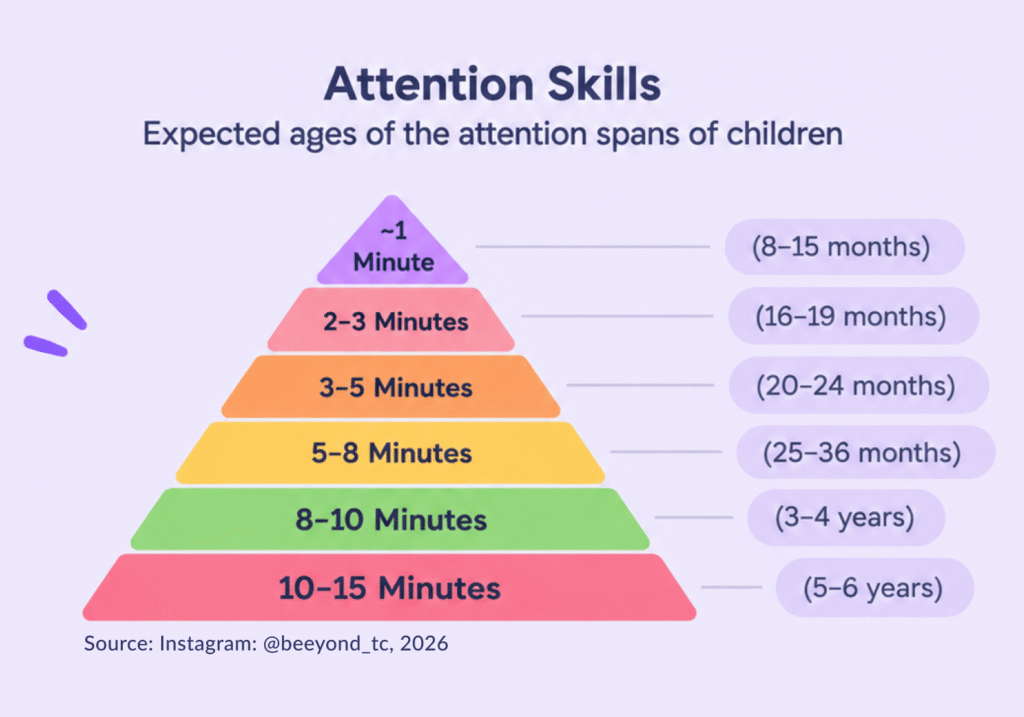
Search for attention span by age and the same rule of thumb keeps appearing: two to five minutes of focus for every year of a child’s age. A pediatric practice in South Florida uses this range, while a child psychologist quoted by Metro Parent suggests three to five minutes per year. Childhood development experts do not even agree on the formula, so any average attention span based on it should be interpreted loosely.
Developmental researchers measure attention span differently. They test how steadily children respond during a long, repetitive task, and the table below sets their findings beside the popular rule.
| Age | Commonly quoted attention span | What research shows | What parents may notice |
|---|---|---|---|
| 5 | 10 to 25 minutes | Sustained attention starts improving quickly | Attention span for play is long, while worksheets fall apart fast |
| 6 to 7 | 12 to 35 minutes | Rapid gains in speed and accuracy | Reminders still needed partway through homework |
| 8 to 9 | 16 to 45 minutes | Rapid gains continue, then begin to slow | Can finish a short homework block alone |
| 10 to 12 | 20 to 60 minutes (the upper limit applies to tasks the child enjoys) | A plateau with smaller improvements | Steadier attention span, though phones and games pull harder |
| 13 to 14 | The attention span formula stops being useful | Attention keeps maturing, along with planning and impulse control | Can study longer but still needs help with distractions |
| Adults | No reliable minute figure | Sustained-attention ability peaks in the early 40s | Attention span depends heavily on the task |
Research sources: Betts et al., 2006; McKay et al., 2010; Fortenbaugh et al., 2015.
The minutes column is the least reliable part of any attention span chart. A child’s ability to stick with a puzzle they chose is very different from their ability to focus on spelling words. Younger children can stay engaged for longer periods when they are moving or building. Comparing a child’s attention span with their own last few weeks says more than any average attention span for their age group.
Is the Average Human Attention Span Really 8 Seconds?
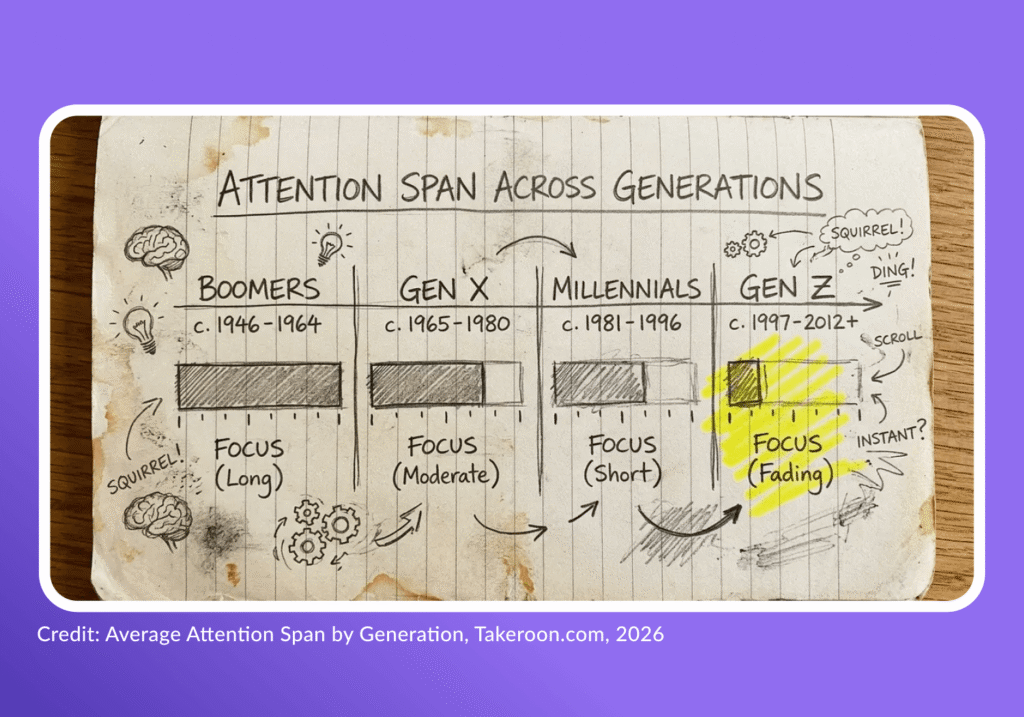
Many parents have heard that the average human attention span has dropped to eight seconds, one second shorter than a goldfish’s. The claim spread in 2015, credited to a Microsoft Canada report. When the BBC traced it, the report had simply cited a website called Statistic Brain, and the BBC found no evidence that the human attention span is shrinking.
Gloria Mark, a professor at the University of California, Irvine, has done real research on attention span and screens. Her team found people stayed on one screen about two and a half minutes in its first study and 47 seconds on average across studies from 2016 to 2020. That measures how often adults switch screens at work, not the average human attention span or how long human beings can concentrate.
A few key statistics put the headlines in perspective:
- Screen switching: about 47 seconds per screen, which reflects work habits rather than the average human attention span.
- Phone checks: the average person picks up and checks their phone 186 times a day, according to a 2026 Reviews.org survey of US adults.
- The goldfish comparison: no credible study supports it.
These key statistics describe adults in limited settings. Attention span statistics like the goldfish claim travel fast because they are simple and attention-grabbing, yet they say little about the average human attention span or whether an 8-year-old can sit through an assembly. Unlike most attention span statistics shared online, the research on children below comes from careful testing.
How Attention Span Changes as Children Grow
Attention starts building in early childhood, but the biggest changes parents notice arrive in the first years of school. As children mature, their attention span gets longer, and they get better at choosing what to focus on.
What Research Shows About Sustained Attention
The most reliable attention span statistics for children come from controlled lab studies. For example, developmental researchers at the University of Melbourne tested the attention span of 57 children aged 5 to 12.
The results showed sustained attention developed rapidly from ages 5 to 6 through 8 to 9, then reached a plateau through 11 to 12, with some measures still improving. A second analysis of the same children found the fastest gains between 5 and 8.
Growth continues past childhood. A study of more than 10,000 people reported that the ability to sustain attention peaks in the early 40s. A UCSF team found that young adults stayed “in the zone” on a task longer than children. This research shows a long attention span develops gradually, alongside brain development and cognitive development, until the average human attention span depends more on the task than on age.
Even among typically developing children, results vary, and developmental researchers treat these trends as averages. A child whose attention span lags at 7 may be right in the middle by 9. Harvard’s short video InBrief: Executive Function: Skills for Life and Learning explains how these skills grow.
Why Does a Child’s Attention Span Vary?
A child who stays with a soccer drill for 40 minutes may struggle to read two pages before dinner. Interest shapes attention span and a child’s ability to focus, and so do environmental factors such as background noise or a tablet glowing within reach.
Many school-age children are also easily distracted in the late afternoon, when they come home hungry and tired. Selective attention takes effort, and a tired brain has less of it. Divided attention slips too, so tired children struggle to maintain focus while juggling instructions, and their attention span shrinks fast. One rough evening says very little about a child’s attention span overall.
What Affects a Child’s Attention Span?
Age sets the general range of attention span, while daily habits decide where a child lands within it. Parents wondering what affects attention span can start with sleep, stress, and how a child learns.
The American Academy of Sleep Medicine recommends 9 to 12 hours for children aged 6 to 12 and 8 to 10 hours for teens, linking enough sleep with better attention and learning. Quality sleep supports cognitive functioning and academic performance, so tired school-age children often struggle with paying attention by mid-morning. A short night chips away at attention span long before lunch.
Chronic stress also affects attention span. Harvard’s Center on the Developing Child explains that toxic stress disrupts the brain circuits needed for executive functioning. A child under chronic stress, such as ongoing conflict at home, may seem to lose the ability to focus when they are really overwhelmed.
A learning disability such as dyslexia can make reading so tiring that the mind drifts, and sensory processing differences can make a scratchy sweater impossible to ignore. These attention challenges are real, even though a short attention span is not the root cause.
Additionally, as a fundamental component of learning, humans are biologically wired to pay attention to what is new (novel) in their environment. As children must learn so much, it’s only natural their attention can be diverted in such cases.
Screen Time, Notifications and Attention in the Digital Age
Screens are the question parents raise most about what affects attention span in the digital age. Between 2019 and 2021, daily entertainment screen time rose from 4 hours 44 minutes to 5 hours 33 minutes among tweens and from 7 hours 22 minutes to 8 hours 39 minutes among teens.
Constant notifications chip away at the ability to focus, too. In a Florida State University experiment, simply receiving a call or text alert hurt performance on an attention-demanding task, even when participants never touched their phones. That drop in task performance shows how a buzzing phone on a homework desk can pull at a child’s focus and shorten their attention span.
A JAMA study of 2,587 high school students found a modest link between frequent digital media use and later ADHD symptoms, measured with a checklist for attention deficit hyperactivity disorder. It could not prove that screens caused those symptoms, but rather that they are related. Still, after an hour of short videos or fast-paced video games, many children find a page of reading hard to settle into.
That constant stimulation is one reason excessive screen time deserves a closer look when a child’s attention span seems to be shrinking. Adults set the tone here: the average person picks up a phone about once every five minutes while awake.
How to Improve a Child’s Attention Span: 7 Practical Tips for Parents
A child’s attention span grows with practice, and a few simple strategies make that practice easier. The aim is to help a child develop sustained focus in small steps rather than long sessions they are not ready for.
Use Kids360 Developmental Activities to Practice Attention and Thinking
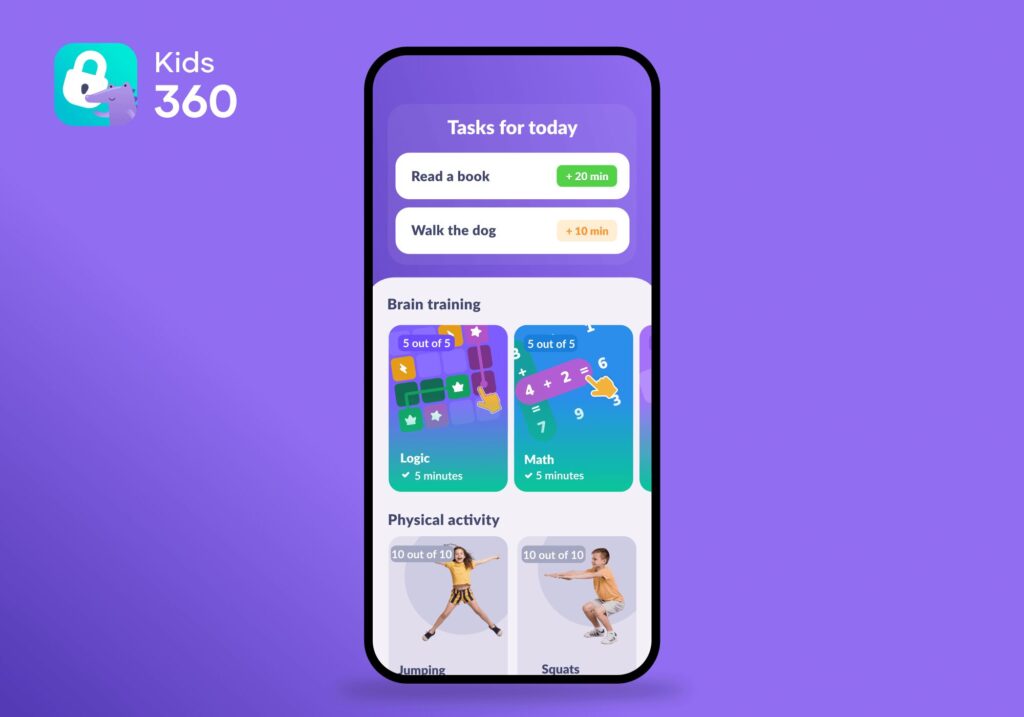
Short tasks are a gentle way to train attention span. Kids360 includes more than 4,400 logic, memory, and math exercises offered as short daily sessions that fit a young attention span. The difficulty adjusts to the child’s age and how quickly they answer correctly, so the tasks stay challenging without becoming frustrating.
Every five solved tasks in a category earn five extra minutes of screen time, up to 20 minutes a day. This turns screen time into a reward for learning, giving children an extra reason to practice their thinking skills before moving on to games. The child practices sustained focus first, then enjoys a game with time they earned. Parents can also create tasks themselves, such as “read for 20 minutes,” with a reward of 5 to 30 minutes. These short sessions build the cognitive skills homework depends on and give children regular opportunities to practice focusing.
Create a Routine and Reduce Distractions

Your child sits down to do homework, opens a math assignment, and five minutes later is checking a game, watching a video, or replying to a message. Sound familiar? It’s hard to concentrate when a phone or tablet keeps offering something more entertaining. A predictable routine can help: agree on homework hours, playtime, and bedtime, so your child knows when it’s time to focus and when they can relax.
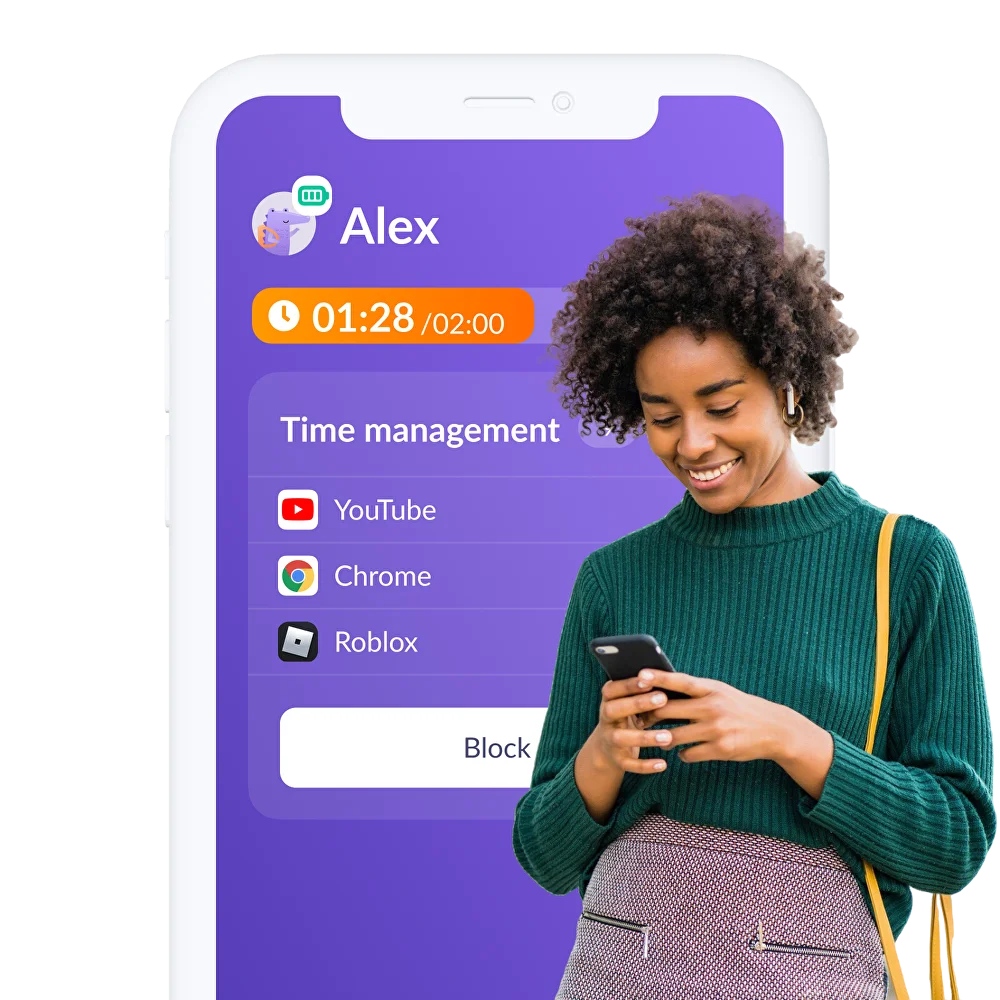
If sticking to those agreements is a daily struggle, Kids360 can help take some of the reminders off your plate. You can set a daily screen-time limit and create schedules that automatically block distracting apps during homework or bedtime. For example, games and social media can stay unavailable from 4 to 5 p.m., while your child can still use essential communication apps. Kids also receive notifications showing how much time they have left, so a restriction doesn’t come as a surprise in the middle of a game.
On Android, you can go a step further and block specific apps if certain games or social networks keep pulling your child away from homework. Kids360 also has eye-protection reminders that prompt a break after an hour of continuous use.
And don’t forget the simple things: turning off unnecessary notifications on the phone can make it easier for everyone to stick to the routine.
Small changes can make a big difference in your child’s ability to focus. Download Kids360 right now for free to keep distracting apps out of homework time and give your child fun ways to practice attention, memory, and logical thinking.
Match Activities to Your Child’s Age and Attention Span
Age-appropriate expectations about attention span make practice feel achievable. A 7-year-old might start with a 10-minute reading block, while a 12-year-old can often manage 25 minutes of math. If a child loses track halfway, the block is likely too long for their current attention span, and shrinking it by five minutes works better than pushing harder.
The child’s age is only a starting point. Younger children maintain focus longer when an activity has a clear finish line, and matching tasks to the child’s ability builds the confidence that makes the next session easier.
Read Together and Discuss Stories
Reading aloud stretches a child’s attention span without feeling like work. A parent might stop at a cliffhanger and ask, “What do you think happens next?” The child has to stay focused through the chapter to answer.
Older children can take turns reading pages. Asking why a character made a choice keeps them paying attention to meaning and builds their ability to focus on longer texts. Bedtime chapters and audiobooks on car rides offer the same sustained focus practice.
Include Physical Activities and Movement Games
A CDC summary found that brief activity breaks of 5 to 10 minutes are linked with better attention and on-task behavior, and research suggests regular physical activity is tied to stronger academic performance. One dance song between homework subjects can reset a child’s ability to focus, and movement breaks help children stay focused when they sit back down.
Kids360 builds movement into its rewards. On a child’s Android phone, an AI trainer counts exercises such as squats through the camera, adding 10 minutes of screen time for every 5 repetitions, and 7,000 steps in a day earn a 5-minute bonus. Active breaks support cognitive health and attention span and give a restless child a better outlet than scrolling.
Break Larger Tasks into Steps That Fit Their Attention Span
A science project due in two weeks is far beyond a 10-year-old’s attention span. Parents can help a child figure out the pieces: a topic on Monday, three facts on Tuesday, a sketch on Wednesday. When children break tasks into small steps, each one fits inside their attention span.
It also helps to identify potential stumbling blocks together, such as missing markers or a busy Thursday. Parents who break tasks into steps can add each one as a separate one-time task in Kids360, and children can break tasks like cleaning a bedroom into clothes, books, then the desk.
Praise Effort and Progress, Not Just Results
“You kept going on that math sheet even when it got tricky” tells your child exactly what they did well. Instead of focusing only on a perfect score, point out the effort, patience, or strategy that helped them get through a challenging task. This way, mistakes don’t have to feel like failure.
You can also use a simple chart to track progress. For example, if your child could focus on reading for 10 minutes last month and now manages 15, celebrate that improvement. Seeing their own progress can help children feel more confident about tackling the next challenge and encourage them to keep trying, even when a task gets difficult.
Kids benefit from adult encouragement when making an effort to pay attention, as well as from gentle reminders when their attention wanders. The key is finding a balance. Follow your child’s cues and offer just enough support to help them stay focused without overwhelming them with prompts.
When Should Parents Be Concerned About a Child’s Attention Span?
Every child loses focus sometimes, so the question is whether a short attention span is passing or lasting. The Centers for Disease Control and Prevention notes that for children with ADHD, the symptoms continue, can be severe, and cause difficulty at school, at home, or with friends. The American Academy of Pediatrics suggests seeing a pediatrician when symptoms have appeared regularly for more than six months.
Signs worth raising with a doctor include:
- Teachers repeatedly raise concerns about the child’s attention or behavior
- Trouble paying attention shows up at home and at school, not only in one place
- Homework that should take 20 minutes regularly stretches to two hours
- The child’s attention span seems short even for activities they enjoy
- Academic difficulties keep appearing despite steady effort
- Chronic stress, poor sleep, or excessive screen time seems to make things worse
A CDC study found that 11.4% of US children aged 3 to 17, about 7.1 million, have ever been diagnosed with attention deficit hyperactivity disorder, and 77.9% of children diagnosed with current ADHD had at least one other condition.
A pediatrician or a specialist in child development can arrange a professional evaluation, the clearest way to understand a child’s attention challenges and whether their attention span is typical for their age. For children diagnosed with ADHD, the CDC says treatment usually combines behavior therapy and medication, and families of children with ADHD can get support through the CDC-funded National Resource Center on ADHD.
There is growing evidence ADHD may be overdiagnosed, particularly in younger children and in boys—when in truth, this often reflects an expected lack of maturation in attention or gender-based physical activity levels. There are also many unreliable ADHD self-administered tests online. This makes it extremely important to connect with credible professionals if you are concerned about your child’s attention.
Help a Child’s Focus Grow One Step at a Time
Charts of attention span by age work best as a loose guide, and any average attention span is only a starting point. Steady progress in attention span matters more, with good sleep, movement, and fewer distractions doing much of the work. In the digital age, that also means giving screen time a clear place in the day so a child’s focus has room to grow.
With Kids360, parents can set homework and bedtime schedules, add logic tasks that reward thinking with extra screen time, and help a child develop a stronger attention span from their own phone. Download Kids360 and set up the family’s focus routine before the next school week.
Sources & References
- The development of sustained attention in children: The effect of age and task load, Child Neuropsychology, 2006
- An examination of developmental trajectories for attention skills in children, Australian Educational and Developmental Psychologist, 2010
- Sustained attention across the life span in a sample of 10,000, Psychological Science, 2015
- Quantifying attention span across the lifespan, Frontiers in Cognition, 2023
- Busting the attention span myth, BBC News, 2017
- How to sharpen your attention and meet your goals, University of California, 2024
- Cell phone usage stats 2026, Reviews.org, 2026
- The Common Sense census: Media use by tweens and teens, 2021, Common Sense Media, 2022
- The attentional cost of receiving a cell phone notification, Journal of Experimental Psychology: Human Perception and Performance, 2015
- Association of digital media use with subsequent symptoms of attention-deficit/hyperactivity disorder among adolescents, JAMA, 2018
- How much sleep do children need?, American Academy of Sleep Medicine, 2016
- InBrief: Executive Function: Skills for Life and Learning (video and brief), Center on the Developing Child at Harvard University, 2012
- Health and academic achievement, Centers for Disease Control and Prevention, 2014
- ADHD in children, Centers for Disease Control and Prevention, 2026
- Symptoms of ADHD, Centers for Disease Control and Prevention, 2026
- ADHD prevalence among U.S. children and adolescents in 2022, Journal of Clinical Child & Adolescent Psychology, 2024
- Understanding ADHD, HealthyChildren.org (American Academy of Pediatrics), 2019
- Children's attention span: How to improve it, Children's Medical Center of South Florida, 2023
- Is There Evidence of ADHD Overdiagnosis in Children?, American Family Physician, 2023
- Average Attention Span by Generation, Takeroon.com, 2026
- Instagram: @beeyond_tc, 2026